
Medical Physicist's Dossier · myOSL™ Chip
Linearity, energy response, fading, angular dependence —the numbers, on one page.
A short, technical dossier for the medical physicist commissioning OSL in-vivo for the first time or switching from the discontinued Landauer nanoDot. The five panels below are internal-testing QA results from the manufacturer type-test programme — the kind of charts that decide whether a detector is worth taking to your linac. Peer-reviewed validation papers (Kowalski 2025, Davis 2025) live on theKnowledge Hub.
Data on this page is reproduced from the manufacturer internal type-test programme. Saxsons Group serves as the authorised Indian distributor and can arrange on-site evaluation against your own reference dosimeters.
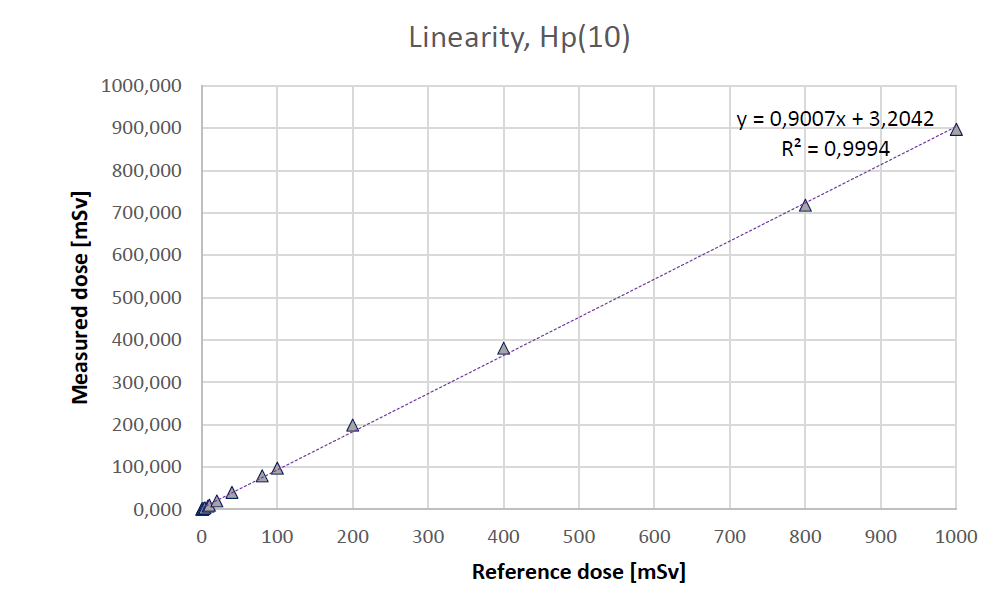
Linearity — personal dose equivalent Hp(10)
Measured Hp(10) vs reference dose, 0 → 1 000 mSv.
Result
R² = 0.9994 · slope 0.9007
Interpretation
Across three orders of magnitude — from background-level (sub-mSv) to accident-tier (1 Sv) — the system's response is linear with R² = 0.9994. A near-unity slope (0.9007) means a single energy-independent calibration factor recovers the reference reading; no piecewise correction needed.
What it means for your workflow
Calibrate once, trust the curve across the full operational dose range.
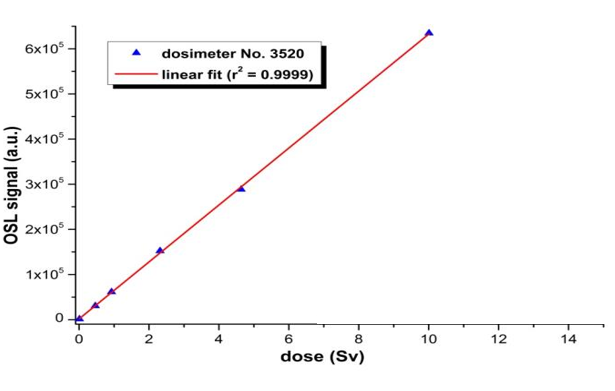
Linearity — extended dose range (radiotherapy regime)
OSL signal (a.u.) vs delivered dose, 0 → 10 Sv (dosimeter #3520).
Result
r² = 0.9999 to 10 Sv
Interpretation
The same linear behaviour holds an order of magnitude further up, into the radiotherapy in-vivo dose regime. r² = 0.9999 from zero to 10 Sv on a single dosimeter means BeO saturation and supralinearity aren't practical concerns at clinical doses.
What it means for your workflow
Safe for in-vivo entrance/exit checks at any clinical fractionation, including SBRT-level single fractions.
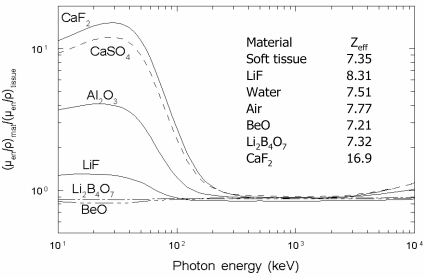
Energy response — tissue equivalence
(μ_en/ρ)_material / (μ_en/ρ)_tissue across 10 keV → 10 MeV photons. BeO compared against CaF₂, CaSO₄, Al₂O₃, LiF, Li₂B₄O₇ and air.
Result
Z_eff 7.21 · flat from ~50 keV upward
Interpretation
BeO's effective atomic number (7.21) sits right next to soft tissue (7.35), so the mass-energy-absorption ratio stays near unity across the entire diagnostic and therapeutic photon range. Above ~50 keV the response is essentially flat — well within ±5 %. Al₂O₃:C (Z_eff ≈ 11) over-responds 2–3× in the kV diagnostic range; BeO does not.
What it means for your workflow
No energy-dependent correction needed for routine kV/MV photon dosimetry. Drop-in replacement for Al₂O₃:C nanoDots without a workflow redesign.
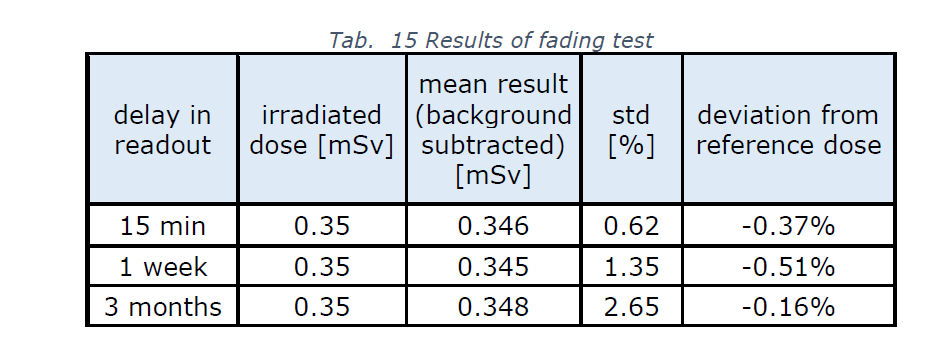
Signal fading — 15 min, 1 week, 3 months
Mean recovered dose at three read-out delays after a 0.35 mSv reference irradiation. Background subtracted.
Result
−0.16 % at 3 months
Interpretation
After 15 minutes the deviation from reference is −0.37 %. After one week, −0.51 %. After three months, −0.16 % — i.e. there is no statistically meaningful fading on a routine quarterly read-out cadence. Read-out scheduling is therefore a logistics question, not a measurement-accuracy question.
What it means for your workflow
Quarterly badge cycles, mailed samples, and delayed-readout protocols all fit comfortably within the system's fade tolerance.
Angular response — front vs side irradiation
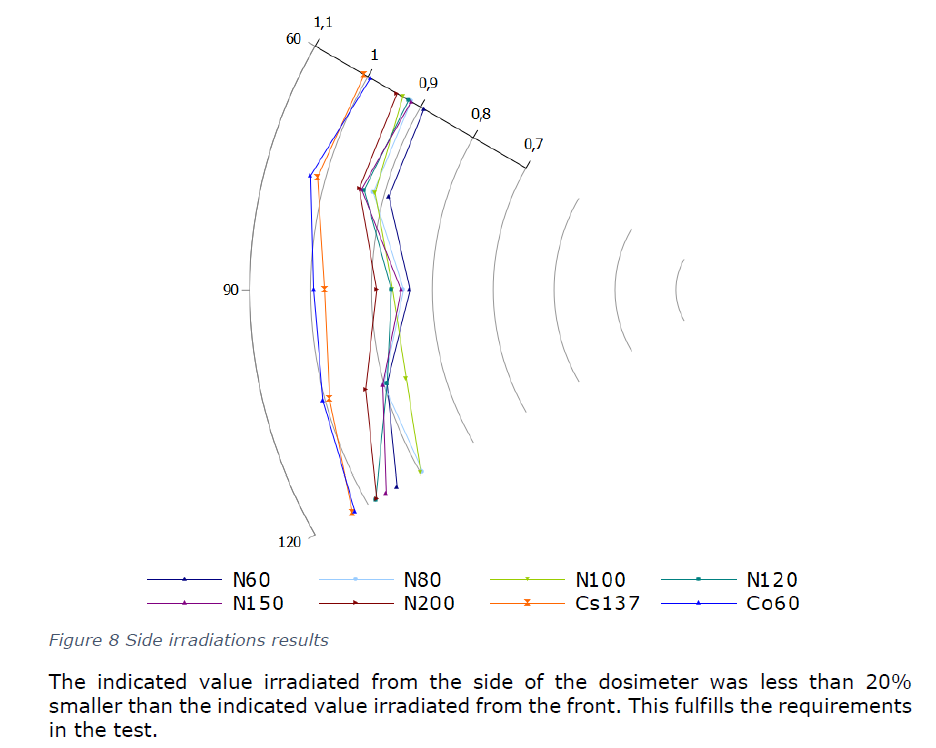
Polar response across 60°, 90°, 120° irradiation angles for ISO N-series narrow-spectrum beams (N60 → N200) plus Cs-137 and Co-60.
Result
< 20 % drop at 90° (side)
Interpretation
Side-on irradiation reduces the indicated value by less than 20 % relative to en-face — well inside the angular-dependence band specified in IEC personal-dosimetry test protocols. Across the full N60 → Co-60 energy range the spread is consistent, so a single angular correction handles real-world badge orientations.
What it means for your workflow
Passes IEC type-test angular requirements. Realistic body-mounted use does not need a per-angle correction.
Summary — at a glance
| Metric | Result | Reference |
|---|---|---|
| Linearity (0 → 1 Sv) | R² 0.9994 | Hp(10) test, slope 0.9007 |
| Linearity (0 → 10 Sv) | r² 0.9999 | extended single-dosimeter test |
| Fading (3 months) | −0.16 % | vs 0.35 mSv reference |
| Fading (1 week) | −0.51 % | σ = 1.35 % |
| Angular response (side vs front) | < 20 % | IEC type-test compliant |
| Tissue equivalence | Z_eff 7.21 | soft tissue 7.35 |
| Detector material | BeO | 4.7 × 4.7 × 0.5 mm element |
| Housing | 9.5 × 10 × 2 mm | ABS light-tight |
Independent peer-reviewed validation (Kowalski 2025 — Duke; Davis 2025 — UVA) confirms these characteristics against the discontinued Landauer nanoDot. Full citations on the Knowledge Hub.
Bring it to your linac
Audit our numbers against your own reference dosimeters.
Saxsons Group will arrange a trial set of myOSL Chip dosimeters and a reader so your physics team can replicate the linearity, fading and angular tests above in your own QA programme — before any commitment.
myOSL™ Chip
More for this product
Sibling posts in the myOSL Chip family.
For Medical Physicist
myOSL Chip vs MOSFET dosimeters
MOSFETs need replacement every 200–400 Gy and most readers max out at 5 channels per module. What changes when you switch to BeO OSL?
Read thisMedical PhysicistWhy BeO OSL fits TBI dosimetry
TBI needs 8–10+ in-vivo points across a long fraction. Where does the myOSL Chip line up with the workflow — and what does the peer-reviewed evidence say?
Read this