
Authorised Indian Distributor
Saxsons Group
New Delhi, India · Since 1997
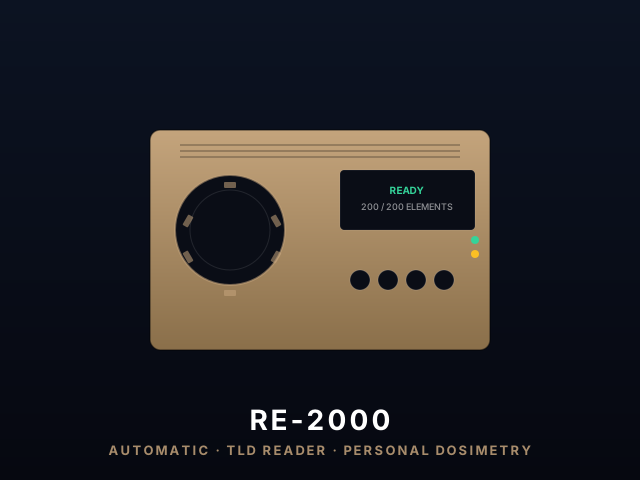
RE-2000Automatic Carousel TLD Reader
A carousel-driven automatic TLD reader sized for a personal-dosimetry service. Three configurations cover the full spectrum — the S model loads 20 whole-body dosimeters (or 80 single elements) per batch; the A model scales to 200 dosimeters / 800 elements for a high-volume service; the RT model reads 1 mm × 6 mm extremity rods for ring and finger badges. Closed-loop QA on every element, hands-off batch operation, and an audit-trail database that fits the documentation expectations of a NABL-accredited or AERB-registered personal-dosimetry service.
Key Features
- Three production-grade configurations — S (low-volume), A (high-volume), RT (extremity rods)
- RE-2000 S: 20 whole-body dosimeters or 80 single TLD elements per carousel load
- RE-2000 A: 200 whole-body dosimeters or 800 single TLD elements per carousel load — built for a busy personal-dosimetry service
- RE-2000 RT: extremity reader for 1 mm × 6 mm TLD rods used in ring badges, finger dosimeters and extremity monitoring of interventional and nuclear-medicine staff
- Closed-loop heating with software-controlled temperature profile, per-element QA, automatic re-read on flagged elements
All Features
- Three production-grade configurations — S (low-volume), A (high-volume), RT (extremity rods)
- RE-2000 S: 20 whole-body dosimeters or 80 single TLD elements per carousel load
- RE-2000 A: 200 whole-body dosimeters or 800 single TLD elements per carousel load — built for a busy personal-dosimetry service
- RE-2000 RT: extremity reader for 1 mm × 6 mm TLD rods used in ring badges, finger dosimeters and extremity monitoring of interventional and nuclear-medicine staff
- Closed-loop heating with software-controlled temperature profile, per-element QA, automatic re-read on flagged elements
- Compatible with LiF:Mg,Ti (TLD-100), LiF:Mg,Cu,P (TLD-100H / MCP-N) and other standard whole-body TLD materials
- Audit-trail database — every read keyed by element ID, operator, reader, calibration factor and timestamp — the document evidence the NABL assessor and AERB inspector both ask for
- Designed for a personal-dosimetry service running monthly / quarterly badge cycles across hospital, industrial-radiography and nuclear-facility client lists
- Available through Saxsons Group with AERB import documentation, India install / commissioning and the matching TLD material supply
Technical Specifications
| Operation mode | Fully automatic carousel-loaded batch readout |
| RE-2000 S capacity | 20 whole-body dosimeters · 80 single TLD elements per load |
| RE-2000 A capacity | 200 whole-body dosimeters · 800 single TLD elements per load |
| RE-2000 RT format | Extremity 1 mm Ø × 6 mm L TLD rods (ring / finger badges) |
| Heating | Closed-loop temperature profile under software control |
| Cooling | Nitrogen-stabilised photomultiplier baseline between elements |
| Detector | Photomultiplier tube |
| Compatible materials | LiF:Mg,Ti (TLD-100) · LiF:Mg,Cu,P (TLD-100H / MCP-N) and other standard TLD materials |
| Software | Windows-class personal-dosimetry-service software — element-keyed audit trail, calibration management, dose-report templates, NABL / AERB-aligned record formats |
| QA features | Per-element sensitivity correction (ECF), per-batch reference checks, automatic re-read on flagged peaks, dark-current and reference-light monitoring |
| Connectivity | Ethernet / USB to host PC, LIS-style export options |
| Power | Mains AC, region-specific configurations available |
| Applications | Personal-dosimetry service (whole-body + extremity), interventional radiology badge service, nuclear-medicine staff monitoring, industrial-radiography NSSD coverage |
Where the RE-2000 fits
Personal-dosimetry service operation — whole-body and extremity, end-to-end
Personal-dosimetry service (whole-body)
A NABL-accredited or AERB-registered service running monthly / quarterly badge cycles across hospital, industrial-radiography and nuclear-facility clients. The S model fits a regional service of 100–500 active badges; the A model scales to a national service of thousands.
Extremity dosimetry (ring / finger badges)
RE-2000 RT reads the 1 mm × 6 mm TLD rods used in ring badges and finger dosimeters. Required for interventional radiologists, interventional cardiologists, nuclear-medicine physicians handling unsealed sources, and brachytherapy staff — anywhere the hand dose exceeds whole-body in any plausible scenario.
Interventional cardiology / radiology staff monitoring
Whole-body badge on the trunk + extremity ring on the dominant hand is the standard ICRP-recommended dosimetry for fluoroscopy-guided interventional work. The combination of RE-2000 A (whole-body) + RE-2000 RT (extremity) covers both legs of the protocol.
Nuclear-medicine technologist + radiopharmacist monitoring
Hot-lab personnel handling unsealed sources need both whole-body and extremity dosimetry. Drawing-up Lu-177 doses, manipulating Tc-99m generators and dispensing F-18 syringes all produce extremity-dominant dose patterns that whole-body badges miss.
AERB-required occupational-dose record-keeping
AERB Safety Code AERB/SC/IR-2 mandates per-worker occupational-dose records with traceable calibration. The RE-2000 audit trail — element-keyed timestamp, operator, calibration factor, reader-ID — is the document evidence the AERB inspector reviews during routine and incident inspections.
NABL-accreditation evidence package
NABL ISO/IEC 17025 accreditation for a personal-dosimetry service requires documented uncertainty budgets, calibration traceability, internal QA records and inter-comparison performance. The closed-loop QA + audit-trail database provides the evidence the NABL assessor walks through during the on-site visit.
Why RE-2000?
The S configuration loads 20 whole-body dosimeters (80 single elements) per carousel cycle — the right fit for a regional in-house service of a few hundred active badges. The A configuration scales to 200 dosimeters (800 elements) per load — built for a national service running thousands of badge cycles per quarter. Same audit trail, same QA closure loop, scaled to the workload.
The RT configuration reads 1 mm Ø × 6 mm L TLD rods — the standard form factor for ring and finger badges issued to interventional cardiologists, interventional radiologists, nuclear-medicine technologists and hot-lab radiopharmacists. The extremity reader runs alongside the whole-body reader on the same audit-trail database, so a worker's whole-body and extremity dose history live in one record set.
Every readout is keyed by element ID, calibration factor, operator, reader and timestamp. That's the document evidence a NABL ISO/IEC 17025 assessor and an AERB inspector both ask for — and the same record set that backs occupational-dose certificates issued to client institutions.
Catalogs & Resources
Manufacturer documentation. Knowledge Hub with the NABL ISO/IEC 17025 + AERB SC/IR-2 framework, IAEA TRS-602 personnel-monitoring guidance and ISO 12794 / ISO 21909 dose-equivalent protocols is in build — contact Saxsons for the current evidence pack.
FAQ
Automatic carousel TLD reader — questions we hear from Indian personal-dosimetry services
When to upgrade from manual to automatic reading, what the per-element audit trail delivers for NABL, which S / A / RT configuration fits which service scope, and the AERB SC/IR-2 + NABL ISO/IEC 17025 framing.
Q.When should a personal-dosimetry service upgrade from manual to automatic TLD reading?
A manual reader reads one TLD at a time — the operator loads each disc / chip, starts the read cycle, records the result and loads the next. Fine for tens to a couple of hundred badges per monitoring period. Above that, the operator time becomes the bottleneck and error rate rises through the shift. An automatic carousel reader (RE-2000) loads a magazine of TLDs and reads them unattended overnight — hundreds to thousands of reads per shift with a per-element audit trail. Above ~500 workers monitored, automatic pays back on operator time alone.
Q.What per-element audit trail does the RE-2000 produce?
Every read records the element ID (carousel position), timestamp, operator ID, heating cycle used, glow curve data, integrated dose reading and calibration factor applied. That is the traceable record a NABL ISO/IEC 17025 auditor reads to verify the reader is producing traceable dose results — not just a spreadsheet of "worker X received Y mGy this month".
Q.Which configurations does the RE-2000 ship in?
S (standard chip / disc), A (annealing-integrated for oven pre-cycle before read), RT (radiotherapy configuration for high-dose work). Configuration is picked against the personal-dosimetry service scope — routine occupational monitoring uses S; departments running their own annealing chain pick A; radiotherapy in-vivo TLD work uses RT.
Q.What NABL / AERB framework does the RE-2000 fit inside?
AERB SC/IR-2 (Individual Monitoring for Occupational Workers) sets the personal-dosimetry-service framework; NABL ISO/IEC 17025 accreditation is required to issue legally-valid dose reports. RE-2000 supports the calibration + read + audit-trail workflow that goes into the ISO/IEC 17025 quality manual. Combines with the matching whole-body and extremity TLD material supply for the full service chain.
Q.How is RE-2000 supplied and supported in India?
Distributed across India by Saxsons Group under SKU DM-007. Supply covers the reader (S / A / RT configuration), AERB import documentation, India install + commissioning, applications training, matching whole-body and extremity TLD material supply, and the NABL accreditation evidence package the service needs for the ISO/IEC 17025 audit.
Setting up or scaling a personal-dosimetry service?
Contact Saxsons Group for RE-2000 pricing (DM-007 — S / A / RT configurations), AERB import documentation, India install + commissioning, applications training, the matching whole-body and extremity TLD material supply, and the NABL accreditation evidence package.