

Authorised Indian Distributor
Saxsons Group
New Delhi, India · Since 1997
Gamma Probe for Sentinel Lymph Node BiopsyEuroprobe™ 3.2 — Intraoperative Gamma Detection for SLN + Radio-Guided Surgery
Intraoperative gamma probe for sentinel lymph node biopsy (SLN) and radio-guided surgery — one handheld console with two scintillator families (CdTe and CsI(Tl)) and 28+ probe geometries. The gamma probe is used to localise the sentinel lymph node in early breast cancer, cutaneous melanoma, cervical, endometrial, vulvar, penile, oral-cavity, prostate and bladder cancers; for radio-guided occult-lesion localisation (ROLL) after I-125 seed implant; for parathyroid adenoma surgery after Tc-99m-MIBI; and for I-131 thyroid-remnant and F-18 radio-guided oncological workflows. CdTe delivers high-sensitivity 20–170 keV coverage (Tc-99m, I-125); CsI(Tl) extends coverage to 100 keV – 1 MeV (I-131 at 364 keV, F-18 at 511 keV). Straight, curved, collimated, laparoscopic (frontal / lateral / 45°) and wireless Bluetooth probes picked per case from the same console. Distributed, installed, trained and serviced across India by Saxsons Healthcare — India's trusted gamma probe supplier since 1988.
Key Features
- Single console + 28+ probe models — one investment covers every SLN and radio-guided workflow the OR team runs
- CdTe scintillator family — high-sensitivity at the Tc-99m (140 keV) and I-125 (27 keV) workhorse range; optimum 20–170 keV
- CsI(Tl) scintillator family — extends coverage to I-131 (364 keV) and F-18 (511 keV with collimator); 100 keV – 1 MeV
- Audio + visual count-rate feedback — pitch rises as the probe approaches the hot node; the surgeon hears the node before the eye finds it
- Auto-switching isotope presets for ⁹⁹ᵐTc, ¹²⁵I, ¹³¹I, ¹¹¹In and ¹⁸F — energy window pre-set, no manual calibration in theatre
All Features
- Single console + 28+ probe models — one investment covers every SLN and radio-guided workflow the OR team runs
- CdTe scintillator family — high-sensitivity at the Tc-99m (140 keV) and I-125 (27 keV) workhorse range; optimum 20–170 keV
- CsI(Tl) scintillator family — extends coverage to I-131 (364 keV) and F-18 (511 keV with collimator); 100 keV – 1 MeV
- Audio + visual count-rate feedback — pitch rises as the probe approaches the hot node; the surgeon hears the node before the eye finds it
- Auto-switching isotope presets for ⁹⁹ᵐTc, ¹²⁵I, ¹³¹I, ¹¹¹In and ¹⁸F — energy window pre-set, no manual calibration in theatre
- 9 customisable user configurations + 1 default — every consultant can save their preferred energy window, threshold and audio profile
- No calibration drift — solid-state scintillator + temperature-stable electronics; no daily warm-up cycle before list start
- Wireless Bluetooth probe variants (-BT) on both CdTe and CsI(Tl) — cable-free OR ergonomics with the same sensitivity profile
- Laparoscopic probe geometry — frontal / lateral / 45° angles for trans-trocar SLN in gynaecological and urological robotic / laparoscopic cases
- Collimated probe variants — tighter directional discrimination against the injection-site hot spot (breast SLN immediately adjacent to peri-areolar injection)
- Maximum count rate 30 000 cps — non-saturating across high-activity I-131 thyroid-remnant and bulk ROLL cases
- Sterile single-use biocompatible probe covers across the full probe range — ISO 10993-5 / -10 / -11 compliance
- Medical-grade stainless-steel probe bodies — autoclavable handle interface; OR-cleaning compatible
- Compact 2 kg console (245 × 233 × 270 mm) — fits the OR side table without crowding the anaesthetic workspace
- CE 0459 (G-Med Class IIa) + FDA-registered (9032627) — regulatory-ready for hospital procurement
Technical Specifications
| Detector families | CdTe (Cadmium Telluride) + CsI(Tl) (Caesium Iodide Thallium-doped) |
| Energy range — CdTe | 20–300 keV (optimum 20–170 keV) |
| Energy range — CsI(Tl) | 100 keV – 1 MeV (optimum 140 keV+) |
| Maximum count rate | Up to 30 000 cps |
| CdTe sensitivity | > 300 Cps/MBq (standard) · > 1500 Cps/MBq (14 mm high-sensitivity) |
| CsI(Tl) sensitivity | > 800 Cps/MBq (standard) · > 1700 Cps/MBq (high-sensitivity) |
| Probe geometry library | Straight · curved · collimated · laparoscopic (frontal / lateral / 45°) · wireless Bluetooth |
| Probe diameter range | 6 mm to 18 mm (CdTe) · 11 mm to 16 mm (CsI(Tl)) |
| Isotope presets | ⁹⁹ᵐTc · ¹²⁵I · ¹³¹I · ¹¹¹In · ¹⁸F — auto-switching energy windows |
| User configurations | 9 customisable + 1 default — per-consultant preset profiles |
| Probe biocompatibility | ISO 10993-5 / -10 / -11; medical-grade stainless steel |
| Sterility | Sterile single-use probe cover for the full probe range |
| Console dimensions | 245 mm (H) × 233 mm (W) × 270 mm (D); 2 kg |
| Power | 115 / 220 VAC, 50 Hz; 15 W maximum consumption |
| Operating temperature | +15 °C to +40 °C |
| Regulatory | CE 0459 (G-Med Class IIa); FDA registered 9032627 |
Applications
Sentinel-node biopsy across breast, melanoma, gynae, urology, ENT — plus ROLL, parathyroid, and selected I-131 / F-18 workflows
Breast SLN biopsy
Tc-99m-nanocolloid / Tc-99m-tilmanocept pre-injection; 6–14 mm CdTe straight or collimated probe; intraoperative axillary node localisation and excision. Collimated probe variants discriminate against the peri-areolar injection-site hot spot.
Melanoma SLN biopsy
Tc-99m-nanocolloid intradermal injection at the primary site; CdTe 11 / 14 mm probe across axillary, inguinal, popliteal, head-and-neck and intransit basins. The cutaneous workflow is the foundational gamma-probe indication.
Gynaecological SLN (cervix, endometrium, vulva)
Open or laparoscopic / robotic SLN across the cervical, endometrial and vulvar cancer pathway. Laparoscopic frontal / lateral / 45° probe variants reach the obturator and external iliac stations through standard trocars.
Penile / urological SLN
Penile cancer inguinal SLN biopsy; selected prostate / bladder cancer protocols. CdTe sensitivity profile matches the typical 30–60 MBq Tc-99m colloid injection.
Head & neck SLN (oral cavity, larynx)
Oral SCC and selected laryngeal cases; the curved probe geometry tracks the floor-of-mouth and submandibular drainage pattern.
Radio-guided occult-lesion localisation (ROLL)
I-125 seed pre-implant for non-palpable breast lesions or soft-tissue masses; the CdTe probe at 27 keV gives clean directional read-out for image-guided excision without intraoperative wire dislodgement risk.
Parathyroid surgery
Tc-99m-MIBI pre-injection on the morning of surgery; collimated CdTe probe localises hyperfunctioning adenoma intraoperatively when the pre-op SPECT-CT is equivocal.
Thyroid-remnant / metastasis (I-131)
CsI(Tl) probe at 364 keV for selected recurrent-thyroid-carcinoma surgery — intraoperative localisation of cervical-nodal disease previously identified on diagnostic I-131 scan.
Radio-guided occult-lesion with F-18 PET tracer
Selected protocols with pre-op F-18-FDG-PET-positive lesions — CsI(Tl) probe with collimator for 511 keV annihilation read-out under tight directional discrimination.
Why Gamma Probe for Sentinel Lymph Node Biopsy?
CdTe covers the high-sensitivity workhorse range (Tc-99m at 140 keV, I-125 at 27 keV); CsI(Tl) extends to I-131 at 364 keV and F-18 at 511 keV. One console runs both — the OR avoids the multi-platform cost when the radiology and theranostic workflows want different energy windows.
Maximum count rate of 30 000 cps handles the hot-spot near the injection site, the bulk-activity ROLL workflow and the high-activity I-131 thyroid case without saturation — the surgeon trusts the count even when the geometry is unfavourable.
Straight, curved, collimated, laparoscopic (frontal / lateral / 45°) and wireless Bluetooth variants from the same console. Pick the geometry per case — the open breast SLN, the laparoscopic gyn-onc pelvic SLN, the ENT floor-of-mouth — without buying a second platform.
Where it's used
Anatomical map — probe selection per surgical area
Eleven surgical areas, the indication, the recommended probe. Hover over a numbered marker on the body for the probe image; cross-reference against the labelled callouts on either side.
3 · Head & neck SLN
Oral SCC, larynx, floor of mouth · Tc-99m
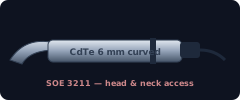
CdTe 6 mm curved — SOE 3211
2 · Parathyroid adenoma
Tc-99m-MIBI · 90 min pre-op IV
CdTe collimated — SOE 3211-AC / 3213-AC
4 · Axillary SLN — breast
Tc-99m-nanocolloid peri-areolar / peritumoural
CdTe 11/14 mm — SOE 3212 / 3213-AC
7 · Popliteal / intransit SLN
Melanoma distal-extremity drainage
CdTe 6 mm — SOE 3211 (small Ø)
10 · Inguinal SLN
Melanoma · penile · vulvar drainage
CdTe 14 mm high-sens — SOE 3213-HS

Thyroid bed / cervical nodes
Recurrent thyroid · I-131 (364 keV)
CsI(Tl) 16 mm — SOE 3222 ± collimator
Parathyroid adenoma
Tc-99m-MIBI · 90 min pre-op IV
CdTe collimated — SOE 3211-AC / 3213-AC
Head & neck SLN
Oral SCC, larynx, floor of mouth · Tc-99m
CdTe 6 mm curved — SOE 3211
Axillary SLN — breast
Tc-99m-nanocolloid peri-areolar
CdTe 11/14 mm — SOE 3212 / 3213-AC
Breast — ROLL / tumour bed
I-125 seed (27 keV) · non-palpable lesion
CdTe 6/11 mm — SOE 3211 (low-E optimum)
Melanoma SLN — skin
Intradermal Tc-99m at primary site
CdTe 11 mm straight — SOE 3212
Pelvic SLN — cervix / endometrium
Laparoscopic / robotic · Tc-99m paracervical
CdTe laparoscopic — SOE 3215 / -L / -45
Prostate / bladder SLN
Robotic / laparoscopic urology · Tc-99m
CdTe laparoscopic — SOE 3215 series
Vulvar SLN (GROINSS-V)
Early vulvar cancer · Tc-99m peri-tumour
CdTe 11 mm straight — SOE 3212
Inguinal SLN
Melanoma · penile · vulvar drainage
CdTe 14 mm high-sens — SOE 3213-HS
Popliteal / intransit SLN
Melanoma distal-extremity drainage
CdTe 6 mm — SOE 3211 (small Ø)
1 · Thyroid bed / cervical nodes
Recurrent thyroid · I-131 (364 keV)
CsI(Tl) 16 mm — SOE 3222 ± collimator
5 · Breast — ROLL / tumour bed
I-125 seed (27 keV) · non-palpable lesion
CdTe 6/11 mm — SOE 3211 (low-E optimum)
6 · Melanoma SLN — skin (multi-basin)
Intradermal Tc-99m at primary site
CdTe 11 mm straight — SOE 3212
8 · Pelvic SLN — cervix / endometrium
Laparoscopic / robotic · Tc-99m paracervical
CdTe laparoscopic — SOE 3215 / -L / -45
Dual opto-nuclear option — SOE 3214-AF
9 · Vulvar SLN (GROINSS-V)
Early vulvar cancer · Tc-99m peri-tumour
CdTe 11 mm straight — SOE 3212
11 · Prostate / bladder SLN
Robotic / laparoscopic urology · Tc-99m
CdTe laparoscopic — SOE 3215 series
Wireless option — any region above
CdTe-BT (SOE 3213-BT) · CsI-BT (SOE 3222-BT)
Footprint
One console · CdTe + CsI(Tl) · > 28 probe geometries · 20 keV – 1 MeV combined coverage
Probe library
Pick the scintillator, pick the geometry
Two scintillator families cover the full clinical energy range. Probe geometry follows the surgical approach: straight for open SLN, curved for floor-of-mouth, collimated against the injection-site hot spot, laparoscopic for trans-trocar gyn / uro cases.
| Probe family | Model codes | Sensitivity | Energy range | Typical use |
|---|---|---|---|---|
| CdTe — sentinel-node workhorse | SOE 3211 / 3212 / 3213 (6 / 11 / 14 mm Ø, straight) | > 300 Cps/MBq | 20–300 keV (optimum 20–170 keV) | Routine SLN — breast, melanoma, gynaecology, ENT, urology |
| CdTe — collimated | SOE 3211-AC / 3213-AC | > 300 Cps/MBq | 20–300 keV | Tight directional discrimination next to the injection site (breast quadrantectomy bed, parathyroid) |
| CdTe — high-sensitivity 14 mm | SOE 3213-HS | > 1500 Cps/MBq | 20–170 keV | Deep / faint nodes; obese pelvis; long count-down workflows |
| CdTe — laparoscopic | SOE 3215 (frontal) / 3215-L (lateral) / 3215-45 (45°) | > 300 Cps/MBq | 20–300 keV | Trans-trocar SLN in gyn / urology robotic + laparoscopic cases |
| CdTe — wireless Bluetooth | SOE 3213-BT | > 300 Cps/MBq | 20–300 keV | Cable-free OR ergonomics; same CdTe sensitivity profile |
| CsI(Tl) — high-energy SLN | SOE 3221 / 3222 (11 / 16 mm Ø) | > 800 Cps/MBq | 100 keV – 1 MeV (optimum 140 keV+) | Higher-energy isotopes (¹³¹I thyroid, ¹⁸F radio-guided occult-lesion localisation) |
| CsI(Tl) — high-sensitivity | SOE 3222-HS | > 1700 Cps/MBq | 100 keV – 1 MeV | High-throughput / deep-node detection at the upper energy range |
| CsI(Tl) — wireless Bluetooth | SOE 3222-BT | > 800 Cps/MBq | 100 keV – 1 MeV | Cable-free high-energy SLN; pairs with the wireless console workflow |
Isotope coverage
From 27 keV to 511 keV — one platform
| Isotope | Photon energy | Probe choice | Clinical use |
|---|---|---|---|
| ⁹⁹ᵐTc | 140 keV | CdTe (any) | Workhorse SLN — breast cancer, melanoma, gynaecological cancers (cervix, vulva, endometrium), penile, ENT (oral cavity, larynx) |
| ¹²⁵I | 27–35 keV | CdTe (low-energy optimum) | Radio-guided occult-lesion localisation (ROLL) for non-palpable breast lesions; seed-localisation surgery |
| ¹¹¹In | 171 / 245 keV | CdTe | Lymphoscintigraphy follow-up cases; occasional ENT / dermatology where In-111 colloid was used |
| ¹³¹I | 364 keV | CsI(Tl) | Thyroid-remnant + occult-thyroid-metastasis intraoperative localisation |
| ¹⁸F | 511 keV | CsI(Tl) (with collimator) | Radio-guided occult-lesion localisation with PET tracer pre-injection (selected centres) |
Ships with the console
What's in the box, what's optional
| Item | Standard / Optional | Why it matters in theatre |
|---|---|---|
| Console | Standard | Europrobe 3.2 readout module — single platform, all probe families, all isotope presets |
| Probe as ordered | Standard | Picked from the CdTe / CsI(Tl) library per the OR list — straight, curved, collimated, laparoscopic or wireless Bluetooth |
| Cables | Standard | Probe-to-console and power cables for the configured workflow |
| Carrying case | Standard | Hospital-grade transport case for OR-to-OR redeployment; tangle-free cable storage between cases |
| Foot-switch | Optional | Hands-free count-rate freeze and mode switch — sterile workflow stays intact during a scrubbed dissection |
| Fluorescence module | Optional | Upgrades the console to dual gamma + ICG NIR fluorescence detection — pairs with the SOE 3214 / 3214-AF opto-nuclear probes (Europrobe Gamma + Fluorescence platform) |
Catalogs & Resources
Product brochure, AERB framework and IAEA gamma-probe reference
Europrobe 3.2 product brochure
Full probe library, sensitivity table, isotope presets and accessory matrix.
AERB Safety Code for Nuclear Medicine Facility
Indian regulatory framework — pre-operative SLN injection authorisation, theatre handling and dose-monitoring expectations.
IAEA Human Health Campus — Gamma Probe
IAEA educational reference on gamma-probe principles, characterisation parameters and intraoperative use.
Videos
Europrobe™ Gamma Detection
More for this product
Each card opens a focused post for a specific specialty — peer-reviewed evidence and clinical workflow, written for the persona you select.
FAQ
Gamma probe, sentinel lymph node biopsy, radio-guided surgery — questions we hear from Indian surgical-oncology teams
What a gamma probe does in the operating theatre, which cancers it is used for, which isotopes it supports, the CdTe-vs-CsI(Tl) trade-off and how the Europrobe 3.2 gamma probe is supported in India.
Q.What is a gamma probe used for in surgery?
A gamma probe is a handheld intraoperative detector that finds tissue containing a small amount of a radioactive tracer. The most common use is sentinel lymph node biopsy (SLN) in breast cancer, melanoma and gynaecological cancers: the patient receives a Tc-99m radiopharmaceutical before surgery, the tracer drains to the first (sentinel) lymph node in the tumour’s drainage basin, and the surgeon uses the gamma probe intraoperatively to localise and excise that node with millimetre precision. Gamma probes are also used for radio-guided occult-lesion localisation (ROLL), parathyroid adenoma surgery, thyroid-remnant surgery (I-131) and selected F-18 radio-guided cases.
Q.Which cancers use gamma-probe-guided sentinel lymph node biopsy?
Sentinel lymph node biopsy with a gamma probe is standard of care for early breast cancer (NSABP B-32, Krag 2010), intermediate-thickness cutaneous melanoma (MSLT-I / MSLT-II, Morton 2014 / Faries 2017), vulvar cancer (GROINSS-V, Van der Zee 2008) and endometrial cancer (SENTI-ENDO, Ballester 2011). Cervical, penile, oral-cavity, laryngeal, prostate and bladder SLN protocols are established in the literature and use the same probe families. The Europrobe 3.2 supports every one of these indications from a single console.
Q.Which isotopes does the Europrobe 3.2 gamma probe support?
Tc-99m (140 keV — the workhorse SLN isotope), I-125 (27–35 keV — ROLL for non-palpable breast lesions), In-111 (171 / 245 keV — lymphoscintigraphy), I-131 (364 keV — thyroid-remnant / metastasis) and F-18 (511 keV — PET-tracer radio-guided occult-lesion localisation, with the collimated CsI(Tl) probe). Each isotope has a pre-set energy window on the console — no manual calibration in theatre.
Q.What is the difference between the CdTe and CsI(Tl) gamma probes?
CdTe (cadmium telluride) is a semiconductor scintillator with peak sensitivity at 20–170 keV — the optimum range for Tc-99m and I-125. Use CdTe for routine breast, melanoma, gynae, ENT, urology SLN and for I-125 seed ROLL. CsI(Tl) (thallium-doped caesium iodide) is a heavier crystal scintillator with useful sensitivity from 100 keV to 1 MeV — the choice for I-131 thyroid-remnant surgery (364 keV) and F-18 radio-guided occult-lesion localisation (511 keV). The Europrobe 3.2 runs both scintillator families from the same console.
Q.Can the Europrobe gamma probe be used for laparoscopic and robotic surgery?
Yes. The Europrobe 3.2 laparoscopic probe series (SOE 3215 frontal / SOE 3215-L lateral / SOE 3215-45 at 45°) passes through standard 10 mm trocars and reaches obturator, external iliac and pre-sacral SLN stations in gynae-oncology and urology robotic / laparoscopic workflows. The wireless Bluetooth CdTe-BT and CsI-BT variants keep the OR ergonomics cable-free.
Q.Is the Europrobe gamma probe available in India? Who supplies it?
The Europrobe 3.2 gamma detection system is supplied, installed and serviced across India by Saxsons Healthcare — trusted radioisotope and oncology-equipment supplier for 40+ years. Distribution covers PAN-India via Saxsons’ established hospital / cancer-centre channel; installation, applications training, AMC and warranty are handled directly by Saxsons.
Gamma Probe for Sentinel Lymph Node Biopsy supplier in India — Saxsons Group
Saxsons Group has supplied onco surgery equipment to over 1,000 Indian hospitals since 1988. Every consignment of Gamma Probe for Sentinel Lymph Node Biopsy ships with cold-chain logistics, AERB import documentation, CDSCO registration references and a Certificate of Analysis delivered before dispatch — the paperwork your radiation-safety and procurement teams need, pre-assembled.
- Nationwide delivery footprint — every metro and tier-2 city in India, scheduled to your treatment / procedure calendar.
- AERB & CDSCO documentation — import licence, radiation-safety paperwork and RSO briefing pre-assembled for the audit file.
- 40+ years in Indian oncology — long-standing supply relationships with AIIMS, Tata Memorial, and hundreds of tertiary-care centres.
- Single point of accountability — one purchase order, one delivery contact, one after-sales team across the whole product family.
Also supplied by Saxsons Group across India
Pick the probe library, pick the OR list
Contact Saxsons Healthcare for CdTe + CsI(Tl) probe selection per OR list, sterile-cover quantities, installation, training, AMC and warranty terms — distributed and supported across India.